Unlike suspended sand or bacteria, “hard water” is usually completely transparent. You cannot see hardness with the naked eye. Yet it is responsible for thousands of Ghana cedis in premature plumbing repairs, destroyed appliances, and daily household frustration.
Tell-Tale Signs of Hard Water in the Home
Crusty White Scale & Spots
Chalky calcium carbonate residue encrusting showerheads, chrome faucets, glassware, and glass shower enclosures that vinegar barely dissolves.
Soap Curd & No Lather
Soap and shampoo fail to foam, requiring excessive quantities. Instead of rinsing clean, soap reacts with calcium to leave a sticky film on skin and tiles.
Dry Skin and Brittle Hair
Mineral residue strips natural oils from skin and hair follicles, exacerbating eczema, dry itchy scalps, and dull, straw-like hair after showering.
Heating Element Failure
Electric kettles, instant shower heaters, washing machine coils, and storage geysers scale up, overheat, draw significantly more electricity, and burn out.
What Makes Water “Hard”?
Water hardness is primarily caused by two dissolved divalent metallic cations: Calcium (Ca2+) and Magnesium (Mg2+).
When rain falls, it absorbs carbon dioxide from the atmosphere and soil, becoming slightly acidic carbonic acid (H2CO3). As this water seeps through underground geological formations containing limestone (CaCO3), dolomite (CaMg(CO3)2), and gypsum (CaSO4), it dissolves these mineral salts into solution.
How an Ion Exchange Water Softener Works
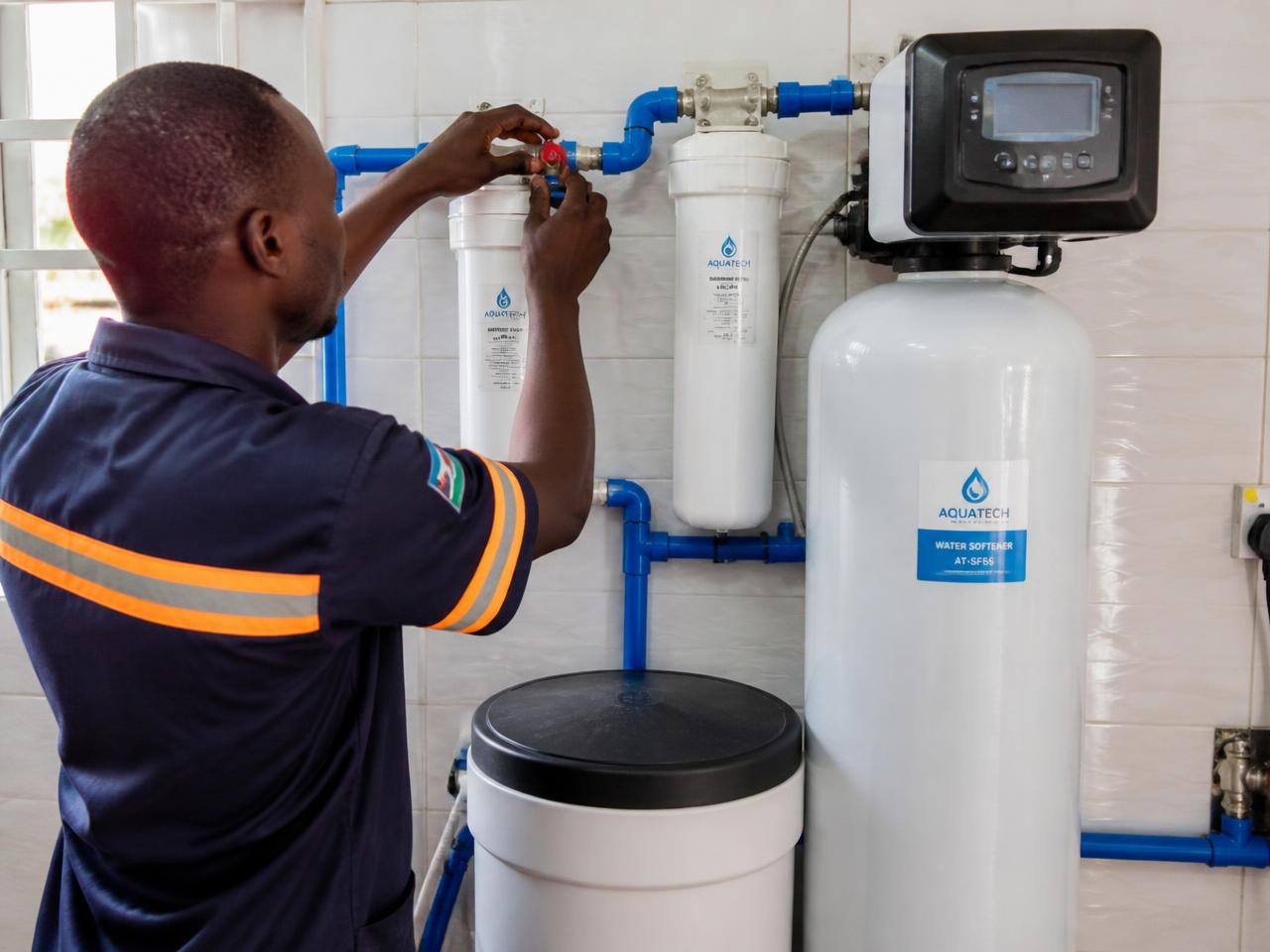
A true water softener does not use physical mesh filters or magnetic gadgets. It utilizes a chemical process called cation ion exchange:
- The Resin Bed: Water flows through a pressure vessel packed with food-grade Strong Acid Cation (SAC) polymer resin beads. Each tiny microscopic bead holds millions of negatively charged exchange sites pre-loaded with sodium ions (Na+).
- The Exchange: Because calcium (Ca2+) and magnesium (Mg2+) carry a stronger positive electrical charge than single-charged sodium (Na+), the resin beads attract the calcium and magnesium tightly. As hard water passes through, the resin grabs the hardness minerals and releases a harmless, equivalent amount of sodium ions in return.
- Automatic Regeneration: Once the resin beads become saturated with calcium and magnesium, the digital automatic control valve initiates a regeneration cycle. It draws concentrated salt water (brine, NaCl) from an adjacent brine tank, floods the resin to displace the captured hardness ions down the drain, and reloads the resin beads with fresh sodium.
Will Softened Water Taste Salty?
No. During softening, sodium bicarbonate is formed — not table salt (sodium chloride). The chloride is flushed down the drain during the rinse cycle. The sodium added is minimal (comparable to the amount in a slice of white bread per glass). However, for people on strict medically prescribed low-sodium diets, an under-sink reverse osmosis system on the kitchen drinking tap removes all sodium cleanly.
Do You Actually Need One? Check Your Water Source
Not every household in Ghana requires a water softener. Hardness varies drastically depending on where your water originates:
- Municipal GWCL Mains: Often originates from treated surface reservoirs (such as the Weija Lake or Kpong Dam). While surface waters can be turbid, they are typically low-to-moderate in dissolved calcium hardness. Many municipal users only need sediment and activated carbon filtration rather than ion exchange softening.
- Groundwater Boreholes: Frequently high in dissolved minerals. Boreholes drilled into coastal sedimentary or limestone formations across Accra Plains, Kasoa, Prampram, or Volta basin often produce very hard water exceeding 250–450 mg/L as CaCO3. Here, a softener is essential to protect plumbing and sanity.
- Vendor Water Tankers: Highly unpredictable. Depending on whether your tanker driver filled up at an approved municipal hydropack or a private untreated borehole, hardness can swing widely from delivery to delivery.
Hardness Classification Scale
In water engineering, total hardness is measured in milligrams per litre (mg/L) or parts per million (ppm) of Calcium Carbonate (CaCO3) equivalent:
- 0 – 60 mg/L: Soft — no softening needed.
- 61 – 120 mg/L: Moderately Hard — minor scale in boiling kettles; softening optional.
- 121 – 180 mg/L: Hard — visible scale on fixtures; water softener recommended to extend heater and appliance life.
- > 180 mg/L: Very Hard — severe scaling, plumbing constriction, soap curd; water softener strongly recommended.
The Verdict
Before purchasing a water softener, have your water tested for Total Hardness and Total Dissolved Solids (TDS). If your total hardness is under 100 mg/L, spending money on a water softener is unnecessary — a high-efficiency multi-media and carbon filtration system will serve your home better.
If your test reveals hardness above 150 mg/L, an automatic ion exchange softener will pay for itself in energy savings, extended appliance lifespan, and drastically reduced detergent and plumbing replacement costs.