Hands-On RO Training
For: Technicians ready for practical work
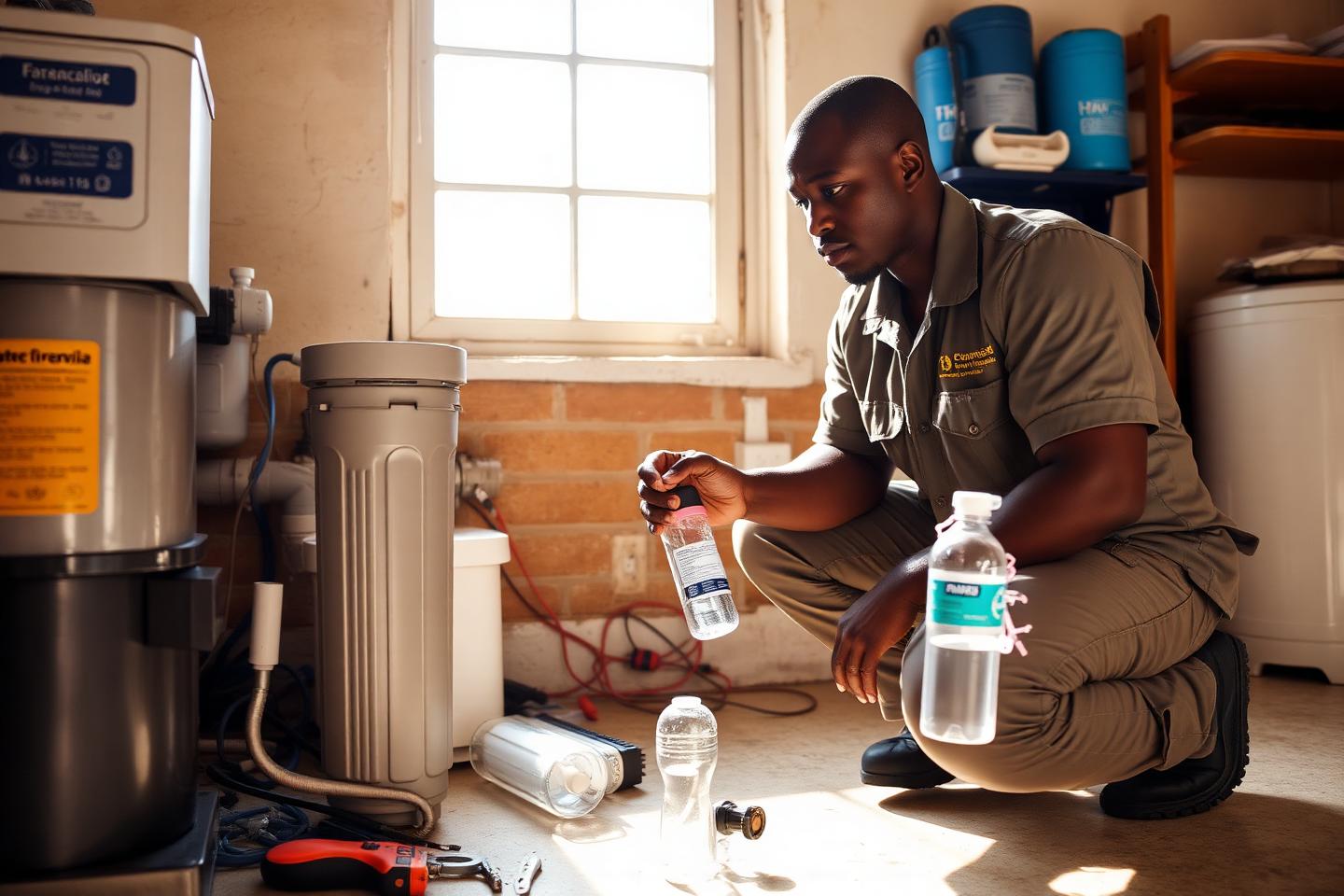
Workshop training on assembly, pre-treatment, CIP, fault-finding and commissioning. Step directly onto the workshop floor and master live commercial and industrial reverse osmosis systems under the direct supervision of practicing engineers.
The Workshop Environment
You do not learn reverse osmosis by watching slide presentations or clicking through software simulators. You learn by tightening high-pressure victaulic couplings, sliding spiral-wound membranes into fiberglass housings, diagnosing cavitation sounds, and mixing real chemical CIP cleanings.
Operating on Live Skid Rigs
Our workshop is outfitted with active, skid-mounted reverse osmosis plants identical to those installed in commercial bottling facilities, pharmaceutical laboratories, and industrial boiler rooms.
You work with multi-stage high-pressure centrifugal pumps, ASME-standard FRP pressure vessels, 4-inch and 8-inch polyamide thin-film composite membranes, electromagnetic flow transmitters, motorized throttling valves, and programmable dosing pumps.
Safety Protocols & Tool Handling
Industrial RO operates under substantial hydraulic pressure (typically 120 to 250+ PSI for brackish water). You learn rigorous shop floor discipline:
- High-pressure lock-out / tag-out (LOTO) procedures.
- Proper membrane handling techniques to avoid brine seal tearing and microbiological contamination.
- Pressure vessel end-cap removal safety and retaining ring inspection.
- Chemical handling PPE for acidic and alkaline CIP formulations.
The Natural Build-Up of Topics
The curriculum follows a strict, logical engineering build-up — mirroring how a plant is planned, assembled, protected, brought online, maintained, and repaired in the real world.
Mechanical Assembly
Skid piping in Schedule 80 PVC and 316 stainless steel. Mounting pressure vessels, aligning high-pressure pump couplings, lubricating O-ring seals with food-grade glycerin, and inserting membrane interconnections without pinching seals.
Pre-Treatment Staging
Configuring multi-media sand/anthracite filters and activated carbon contactors. Installing 5-micron and 1-micron spun polypropylene cartridge filters. Sizing antiscalant dosing rates to prevent calcium sulfate and carbonate precipitation.
Commissioning & Start-Up
Executing low-pressure water flushes to purge entrapped air. Gradually throttling the concentrate valve to prevent water hammer. Optimising recovery rates by balancing water efficiency against scaling risk, and logging baseline permeate flux and salt rejection data.
Clean-In-Place (CIP)
Diagnosing foulants before cleaning. Executing low-pH acid cleanings (citric acid/HCl) for mineral scale, and high-pH alkaline cleanings (NaOH/EDTA) for organic slime and biofilm. Managing CIP tank heating, soaking, and recirculation flows.
Systematic Fault-Finding & Troubleshooting
Technicians are judged by how effectively they solve breakdowns. In this capstone module, our engineers introduce controlled faults into the training rigs:
Diagnosing particulate fouling on the feed spacer of lead elements vs. tail element scaling.
Using permeate probing to pinpoint cracked end-cap O-rings vs. widespread membrane degradation.
Locating inlet suction restrictions, clogged cartridge housings, and air ingress in supply lines.
Frequently Asked Questions
Common questions from technicians preparing for workshop training.
Do I need to complete Online Courses first?
Completing the Online Courses track is helpful because it covers the underlying water chemistry and mathematical calculation methods. However, it is not strictly required. If you already have practical trade experience in pipework, facilities maintenance, electrical controls, or pump mechanics, you can enroll directly into this hands-on workshop track subject to an initial technical assessment.
What equipment will I actually work on?
You will operate directly on live commercial and industrial reverse osmosis systems in a fully equipped workshop setting. You will handle multi-stage high-pressure pumps, fiberglass pressure vessels (FRP), industrial spiral-wound polyamide membrane elements, chemical CIP recirculation tanks, flow rotameters, digital conductivity transmitters, and pressure relief valves. Specific equipment models, capacity ratings, and workshop schedules are confirmed at enrollment.
Build Your Full Competency Profile
Pair physical workshop execution with theoretical science or advanced plant tuning:
Online Courses
Build deep scientific understanding of water chemistry, laboratory testing, dosing mathematics, and treatment unit operations at your own pace alongside your workshop practice.
Explore Online Courses →Advanced RO Training
Ready to progress further? Master ASTM temperature normalisation, membrane autopsy forensic analysis, and closed-loop PLC automation for large-scale utility plants.
Explore Advanced RO →Reserve Your Workshop Bench
Learn real reverse osmosis assembly, commissioning, and fault diagnostics on live systems. Intakes are limited — places are confirmed in order of application.