
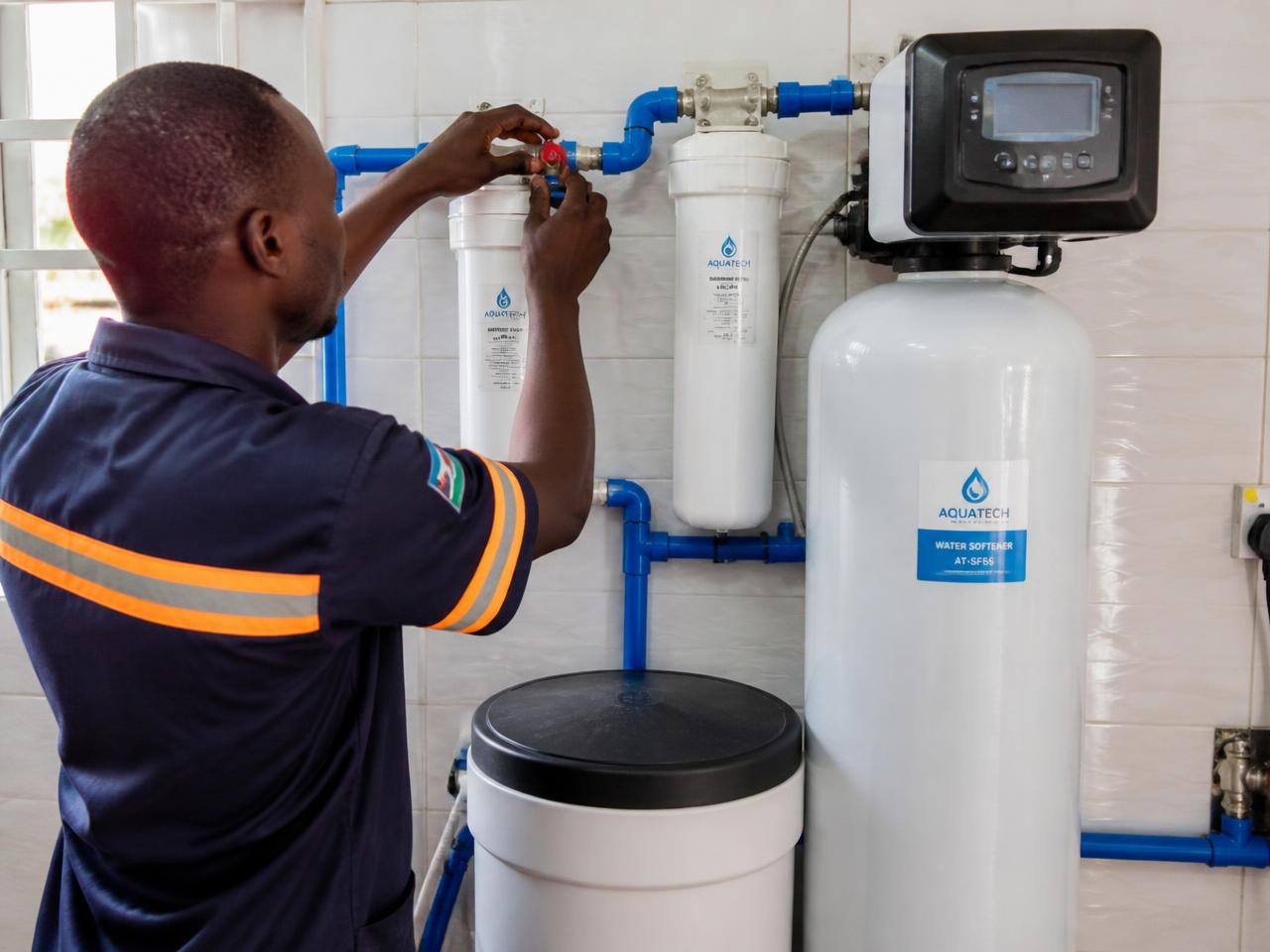
When borehole water runs brown, most property owners immediately assume “the borehole is dirty” and purchase a standard sediment cartridge or sand filter. When that filter clogs within two days — or fails to clear the water at all — the confusion begins.
In groundwater engineering, brown water is almost never just “dirt.” Across Ghana’s varied hydrogeological terrain — from the coastal sands of Greater Accra and Central Region to the Birimian granites and Tarkwaian formations — discoloured borehole water stems from one of three fundamentally different mechanisms:
Dissolved Iron & Manganese
Clear when pumped from underground, but turns reddish-brown or black as it hits oxygen in your storage tank.
Physical Silt & Clay Sediment
Cloudy or turbid immediately upon discharge; fine suspended mineral particulates that settle to the bottom of a glass over hours.
Iron Bacteria Infestation
Forms stringy orange-brown slime, oily sheens on tank surfaces, and foul musty or swampy odours in pipes.
Cause 1: Dissolved Iron & Manganese (Chemical Oxidation)
Deep underground, groundwater exists in an anaerobic (oxygen-depleted), reducing environment under pressure. In this environment, naturally occurring iron minerals dissolve into the water as soluble ferrous iron (Fe2+).
When ferrous iron is dissolved in water, the water is completely clear at the wellhead. You can pump it into a clean glass and it looks like pure drinking water. However, the moment that water enters your surface holding tank or is exposed to atmospheric oxygen, a chemical reaction occurs:
The Oxidation Reaction
4Fe2+ + O2 + 10H2O → 4Fe(OH)3 ↓ (insoluble ferric hydroxide precipitate) + 8H+
The soluble iron oxidises into solid, insoluble rust particles. If manganese is also present (Mn2+), it oxidises into black manganese dioxide (MnO2) flecks, causing dark purplish-brown stains on sanitaryware and laundry.
Why standard cartridge filters fail: If you install a cartridge filter before oxidation completes, the iron passes right through the filter pores as a dissolved liquid, only to precipitate as brown sludge inside your overhead tank, water heater, and toilet cisterns.
Cause 2: Suspended Sediment and Aquifer Turbidity
Unlike dissolved iron, physical sediment is already visible in particulate form the instant the water leaves the borehole pipe. This turbidity consists of microscopic silica sand, silt, or colloidal clay particles drawn from the aquifer formation.
Common causes include:
- Improper screen slot sizing: The borehole casing screens were cut too wide for the surrounding sand grain size.
- Inadequate gravel packing: The annular space around the casing was gravel-packed with poorly sorted aggregate.
- Incomplete well development: Fine geological drill cuttings were not properly purged from the aquifer before the submersible pump was commissioned.
- Seasonal water table drawdown: During dry periods, dropping water levels cause aquifer collapse or turbulence around the pump intake.
Cause 3: Iron Bacteria Colonies
Iron bacteria (such as Gallionella, Crenothrix, and Leptothrix) are naturally occurring microorganisms that derive their metabolic energy by oxidising dissolved ferrous iron into ferric state. As they do this, they produce thick, gelatinous, orange-brown slime matrices.
Key indicators of iron bacteria:
- A greasy or oily-looking rainbow sheen on the surface of your overhead Polytank.
- Thick, sticky reddish-orange sludge coating the inside walls of the storage tank and toilet cisterns.
- Swampy, musty, or decayed vegetation odours when opening hot or cold taps.
Standard physical filters will quickly become completely choked with bacterial slime within days. Physical filtration alone cannot solve a biological infestation.
The 5-Minute Clear Glass Diagnostic Test
Before spending money on treatment systems, perform this simple diagnostic test at home:
The Glass Test Protocol
- Draw a clean, clear glass of water straight from the borehole tap before it enters any tank.
- Observation 1: Is it brown immediately? If yes, it is likely physical sediment or already-oxidised surface water infiltration.
- Observation 2: Is it crystal clear when drawn, but turns reddish-cloudy after sitting on a table exposed to air for 30 to 60 minutes? If yes, you have dissolved iron (Fe2+).
- Observation 3: Does the water leave a stringy, sticky residue inside the glass that smears like jelly? If yes, iron bacteria are present.
Why Proper Testing Saves Thousands
Each of these three problems requires completely distinct engineering interventions:
- For Dissolved Iron: Requires an oxidation step (aeration, chlorine injection, or catalytic media such as Katalox Light or Birm) to convert the iron to solid form, followed by depth media filtration. Water pH must also be measured, because Birm requires a pH of at least 6.8 to function.
- For Physical Sediment: Requires high-capacity Multi-Media Filtration (graded quartz, garnet, and anthracite) with proper automatic backwashing.
- For Iron Bacteria: Requires shock chlorination of the borehole wellbore and storage cisterns with high-concentration sodium hypochlorite, followed by continuous residual disinfection.
Attempting to treat dissolved iron with a simple carbon cartridge or treating bacterial slime with a sediment filter is one of the most common causes of wasted money in Ghanaian domestic water treatment. A comprehensive on-site water quality analysis confirms exact levels of iron, manganese, pH, total dissolved solids, and microbial load before any equipment is specified.